UX/UI Design • Product Design • UX Research
SCHED App Case Study
A UX case study exploring how families can manage busy schedules and keep up with each other's appointments — from research through high-fidelity prototype.
The product
A scheduling app designed for busy families to track events and appointments.
Duration
March 2024 – May 2024
My role
Lead UX Designer · UX Researcher · Visual Designer
Responsibilities
Challenge
The problem & the goal
“I want for my family and I to keep up with each other's appointments and events. It is difficult to remember everything with my own busy schedule.”
The problem
Families struggle to stay coordinated across busy, overlapping schedules — leading to missed appointments, forgotten events, and communication breakdowns.
The goal
Design a dedicated family scheduling platform that helps households manage their own schedules and stay informed about each other's commitments — all in one centralized, user-friendly app.
Research
User research: pain points
Interviews and research surfaced four recurring frustrations that shaped the design direction.
Syncing issues
Apps don't sync properly across devices or with other calendars.
Limited accessibility
Availability on only certain platforms excludes some family members.
Notification overload
Too many alerts lead users to ignore the important ones.
Complexity
Too many features and cluttered interfaces make apps hard to use.
Persona
Meet Jade
Primary persona
Jade, 34
Medical writer, married with three small children.
Goal
Organize the family schedule and ensure everyone is where they need to be on time.
Pain point
Constant juggling of work and family obligations leads to forgotten events and mounting stress.
Mapping Jade's user journey revealed how helpful a dedicated SCHED family scheduling platform would be.
Design
Wireframing & low-fidelity prototype
Paper wireframes
Explored a homepage from which every other page is accessible, establishing the core navigation structure.
Digital wireframes
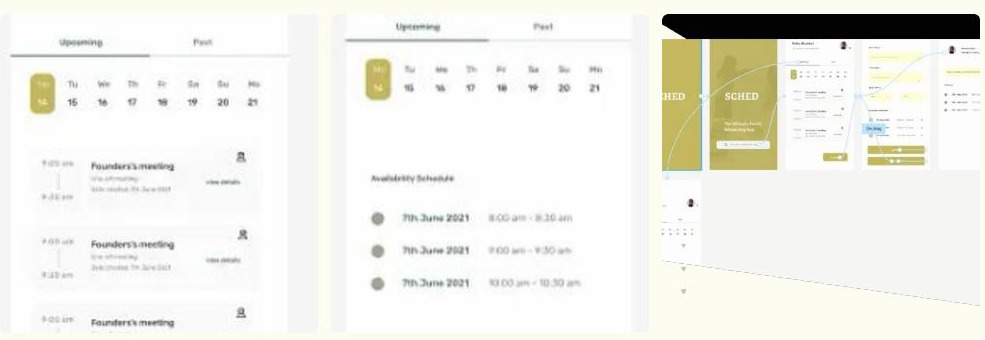
Designed an app where families manage their own schedules and help with each other's.
Prototype navigation
Profile pictures link to individual pages, the mini calendar opens the monthly view, and daily/weekly pages stay one tap away.
Testing
Usability study findings
Round 1
Confusion with the interface layout, customization preferences surfaced, and adding or editing events needed to be easier.
Round 2
Feature prioritization feedback, communication needs identified, and integration challenges with existing tools.
Inclusive design
Accessibility & impact
Accessibility features
- Multilingual support
- Text-to-speech
- Accessibility-conscious contrast
- Screen reader considerations
- Voice commands
Key impact
Families struggle with fragmented schedules — there is strong demand for a centralized, user-friendly platform that brings everyone together.
Future opportunities
Chore assignment, family chat, location sharing, and calendar integration with third-party apps.
What I learned
A successful family scheduler bridges communication gaps, simplifies organization, and fosters connection.
Next steps: expand research across a wider range of family structures, build iterative prototypes to validate decisions with real users, and refine continuously based on usability insights.
Launch your project